Type of protection “E” increased safety
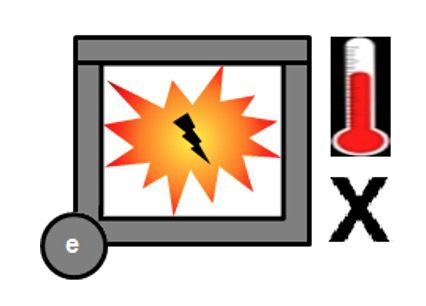
EMMUA 214 States: Page 17
3.4.1 Definition A type of protection in which additional measures are applied, so as to give increased security against the possibility of excessive temperatures and of the occurrence of arcs and sparks in normal service or under specified abnormal conditions.
3.4.2 Standards and selection
i) Current standards
IEC 60079-7 (EN 60079-7) Explosive atmospheres - Part 7: Equipment protection by increased safety ‘e’.
ii) Superseded standards
EN 50019 Electrical apparatus for potentially explosive atmospheres. Increased safety ‘e’; BS 5501 Part 6 Increased safety ‘e’.
iii) EPL/category and zones of use
Increased safety equipment may be used in areas requiring EPL ‘Gb’ and ‘Gc’, or Category 2 and 3 only. Prior to 2007 it was permitted to
use such equipment in Zones 1 and 2 only.
iv) Use with gas subdivisions
Certified increased safety Ex ‘e’ equipment may be used with all Group Il gas subdivisions A, B or C. The marking does not specify the subdivision, just Il, followed by other required details. However, a combination of increased safety with the flameproof concept may result in a need for subdivisioning. Notes: Recently IEC has dropped the Group Il marking and now requires equipment to be marked IIA, 11B or IIC.
3.4.3 Construction and use
i) Connection and Junction Boxes
The manufacturer’s details of terminal types, sizes, number of terminals, conductor size and maximum current ratings are to be followed.
ii) Overload Protection
The overload protection of an Ex ‘e’ machine is fundamental to its certification and therefore should not be altered or adjusted without reference to the appropriate superior technical authority.
ii) Ingress Protection
Type of protection ‘e’ requires an Ingress protection of IP54 as minimum, but location conditions may demand a higher value.
Type of protection ‘e’, increased safety, is a type of protection applied to electrical equipment in which additional measures are applied so as to give increased security against the possibility of excessive temperatures and the occurrence of arcs and sparks in normal service or under specified abnormal conditions.
EPL/ Category and zones of use
Increased safety equipment may be used in areas requiring EPL ‘Gb” and ‘Gc’, or Category 2 or 3 only. Prior to 2007, it was only permitted to use such equipment in Zones 1 and 2 only.
Characteristics
Non-sparking
This type of characteristic can only be applied to electrical equipment which do not produce sparks and do not exceed specific temperatures during normal operation or in specific abnormal operation such as a motor overload or lamp failure.
Robust and impact resistant
Ex e equipment is robust and is tested to ensure it meets the requirements of the impact test specified in IEC 60079-0.
Terminations
The following applies to increased safety terminations:
- Ex e terminals have greater creepage and clearance distances than normally used
- Terminals need to be constructed with integral locking devices to avoid inadvertent loosening which could lead to arcing and sparking.
- Terminals are de-rated from their standard industrial current rating to limit the possibility of high temperatures developing.

Manufacturers of certified Ex e junction boxes specify terminal type, size and maximum current and voltage ratings. The insulation of each conductor is to be maintained right up to the metal of the terminal.
Ingress protection
Ingress protection for Ex ‘e’ equipment containing bare live parts is normally IP54 or higher
A protection method in which increased measures are taken to prevent the possibility, during normal operation, of excessive HEAT, ARCS or SPARKS occurring on internal or external parts of the apparatus.
This method of protection achieves safety by removing the possible sources of ignition.
- Protection method is suitable for Zone 1 and Zone 2 uses.
- Gas Grouping and Temperature Class applies as described in Sections 5.2 and 5.3
Requirements for Increased Safety method are:
- Larger conductors
- Larger clearances between terminals and parts of apparatus
- Spark proof terminals
- Good enclosure and cable gland structure to withstand 4 to 7 Joules impact
- Automatic electrical protection of rotating machines
- Light fittings to have lamps with lower temperature than apparatus rating
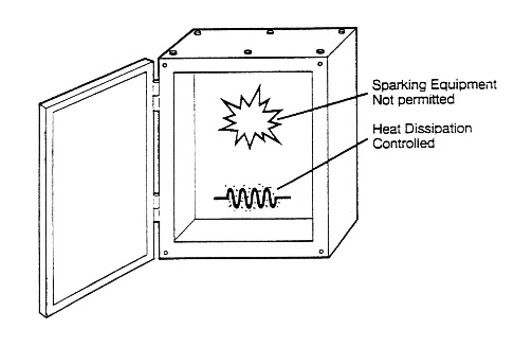
Enclosures containing live parts will be constructed to ingress protection level IP54, or better.
Cover seals will be fixed rubber gaskets or O-rings held in position on the cover.
Materials of construction can be plastic, stainless steel, or cast metal.
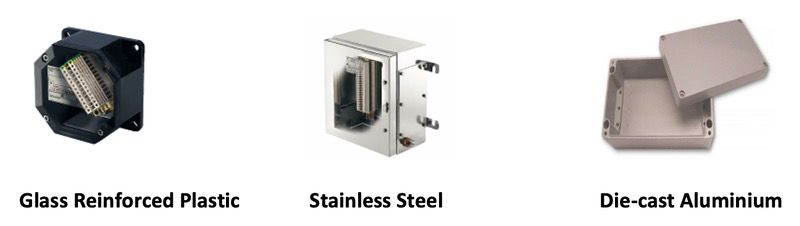
The glass reinforced plastic (GRP) enclosure can be supplied with an internal earth continuity plate to allow easy earthing of all metallic cable glands to main process plant earth.